
History
Efforts to preserve Haná folklore in Doloplazy date back to the years just after the war. The Olešnica ensemble was founded in 1969.
Milestones
1947
The first Haná Wedding
The first large Haná festival is held in the village.
1957
The Haná Wedding folk festival
Based on Stanislav Krejčí, with groups from Troubky, Veselíčko, Dolany, Prostějov and Droždín.
1968
Haná harvest festival
For the 50th anniversary of the republic, with the Moravian Beseda dance rehearsed with dancers from Troubky.
1969
Olešnica is founded
On 11 July the ensemble is founded with 29 adults and 16 children; on 24 August it performs for the first time in Velký Týnec.
1972
First trip abroad
70 members travel to the festival of Sorbian culture in the GDR.
80. léta
Festivals across Europe
Bulgaria, Denmark, Hungary, Austria, the GDR, France.
90. léta
A new generation
After a generational crisis new dancers join and the ensemble travels to Jarosław in Poland.
2019
50 years of the ensemble
Celebrating half a century of Olešnica.
2024
55 years of the ensemble
The Friends of Folklore meeting in the Doloplazy community hall.
How it all began
Efforts to preserve Haná folklore in our village date back to the period just after the war. The greatest credit for starting and supporting them goes to the circle of friends around Mr Bohumil Zdařil and his wife, Mr Augustýn Navrátil, the Dočkal, Tomeček and Malíček families and others. Their interest in Haná folklore – in presenting long-forgotten Haná dances, songs and customs, in reviving the dialect and the Haná costume with all its parts – was what drove them.
In 1947 the village held its first large Haná festival, the Haná Wedding. At that time a collaboration began with Mrs Marie Vařechová from Prostějov, who embroidered costumes, and with members of the Mánes Haná ensemble from Prostějov, who gladly passed on their experience. In the 1950s further Haná festivals were prepared under the auspices of the Orel association, the local fire brigade or the gardeners’ club. In 1951 the Haná ensemble from Troubky near Přerov performed at the Maypole festival in Doloplazy. Six years later, in 1957, a large folk festival, the Haná Wedding based on Stanislav Krejčí, took place with folk groups from Troubky, Veselíčko, Dolany, Prostějov and Droždín.
In the following years this folk activity in Doloplazy seemed to fade away.
It was not until 1968, for the 50th anniversary of the founding of the republic, that Bohumil Zdařil, Ing. Václav Tomeček, Jaroslav Dočkal, Jan Malíček and others organised the Haná harvest festival. The ensembles Hanačka from Slatinice and Mánes from Prostějov performed as guests.
The Kabelandr couple from Troubky, together with a group of dancers, rehearsed the Moravian Beseda with the dancers from Doloplazy. The success of the programme and of the whole festival is shown by the fact that the Doloplazy group was invited to perform in Drahlov. Rehearsals therefore continued, and so on 11 July 1969 a Haná ensemble was founded under the local adult education society. At that time it had 29 adult members, and the children’s group founded at the same time had 16 children. At one of the first rehearsals the members agreed to name the ensemble Olešnica, after the local name of a nearby brook. Ing. Václav Tomeček became its organisational leader. One of the first performances took place on 24 August 1969 at the Hop Festival in Velký Týnec, where Olešnica danced the Moravian Beseda, adults and children together. This performance was important because the members met Dr Alois Běhal from Přerov there. Dr Běhal had been studying Haná folklore for many years, led the ensemble of the railway apprentice school in Přerov and worked for the ensemble from Troubky. He got in touch with our enthusiastic dancers and promised to cooperate. He kept his promise and for many years became the ensemble’s rehearsal leader and choreographer, teaching our dancers the Haná dances collected and written down by Mrs Ludmila Mátlová. His cooperation was of immense importance for the ensemble. Among other important figures who contributed to the quality of the programme we must name the singing teacher and excellent musician František Švarc, thanks to whom the ensemble had an excellent Haná band. We also remember with respect and gratitude the folk storyteller and singer Josef Kubáč and other members of the ensemble.
The ensemble flourished, gaining new members, above all children and young people. At the end of May 1972 the ensemble set off with 70 members on its first trip abroad, to the 3rd Festival of Sorbian Culture in the GDR. After Dr Běhal, choreography and rehearsals were very successfully taken over by long-standing members Pavel Zdařil and Iva Zdařilová, who gradually prepared new material for all sections of the ensemble. This is how the themed suites Wedding, Village Feast, Recruits and Conscripts came into being, as well as other individual dances and programmes.
In the 1980s the ensemble performed widely not only in Czechoslovakia but also abroad, for example in Bulgaria, Denmark, Hungary, Austria, the GDR and France. At the beginning of the 1990s the ensemble went through a generational crisis, which it overcame only thanks to its organisational leader Ing. Václav Tomeček and Mr Pavel Zdařil, who resumed the rehearsals and trained new dancers, bringing a new generation into the ensemble. After its first performances in the Czech Republic came the first trip abroad, to the International Folklore Festival in Jarosław, Poland. In the following years the ensemble regularly presented Haná customs, songs and dances at many performances and festivals at home and abroad, bringing Haná folk culture closer to audiences in Austria, Slovakia, Slovenia, Italy, the Netherlands and Serbia.
At that time Miroslav Bílek took over the leadership of the ensemble and Iva Zdařilová the choreography. Until the 1990s the ensemble had its own band; today it works with Jan Malíček’s folk band, whose leader also arranges the music.
Since its foundation the ensemble has organised many cultural events under the local adult education society of Doloplazy. The most important of them is the Ride of the Kings folk festival, where every year audiences can see local ensembles as well as many from abroad.
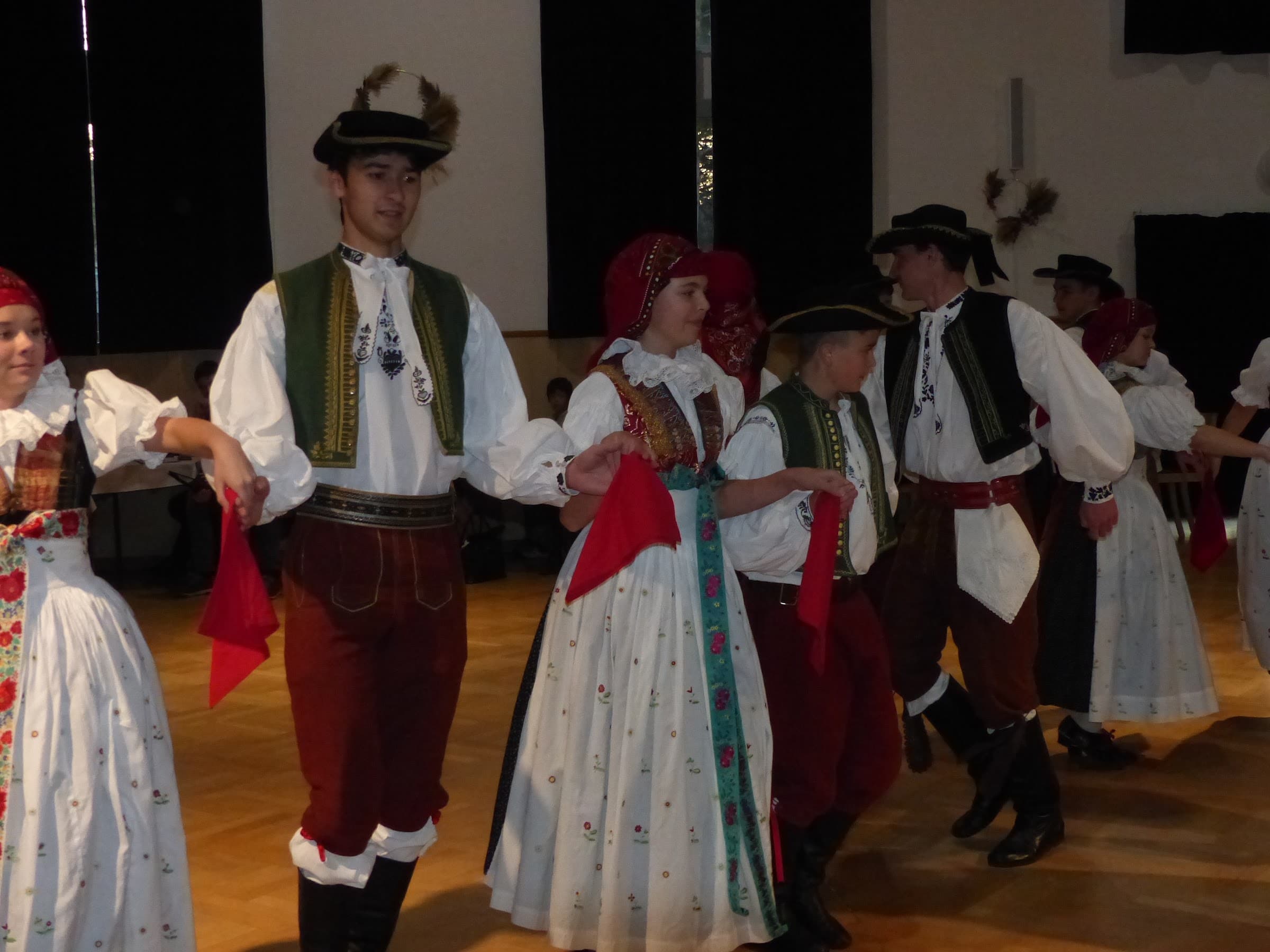
Since its foundation the ensemble has organised many cultural events in Doloplazy. The most important of them is the folk festival the Ride of the Kings, where every year audiences can see local ensembles as well as many from abroad.